

Gold has a property no other material shares: it does not rust, tarnish or decay. A gold ornament buried for six thousand years comes out of the ground looking almost exactly as it did on the day it was made. That permanence — together with its rarity, its warm colour and the fact that it can be hammered into sheets thinner than paper — is why every great civilisation has treasured it, and why gold is still the world’s ultimate store of value.
The first gold (c. 4500 BC)
The oldest worked gold known to archaeology was discovered in 1972 in the Varna Necropolis on Bulgaria’s Black Sea coast. Its graves, dated to roughly 4600–4200 BC, contained thousands of gold objects — bracelets, beads, appliqués and sceptres — showing that skilled goldsmithing existed more than 6,000 years ago. Early gold was almost always placer or alluvial gold: grains and nuggets washed out of rock and collected from riverbeds by panning.
Egypt and the gold of Nubia
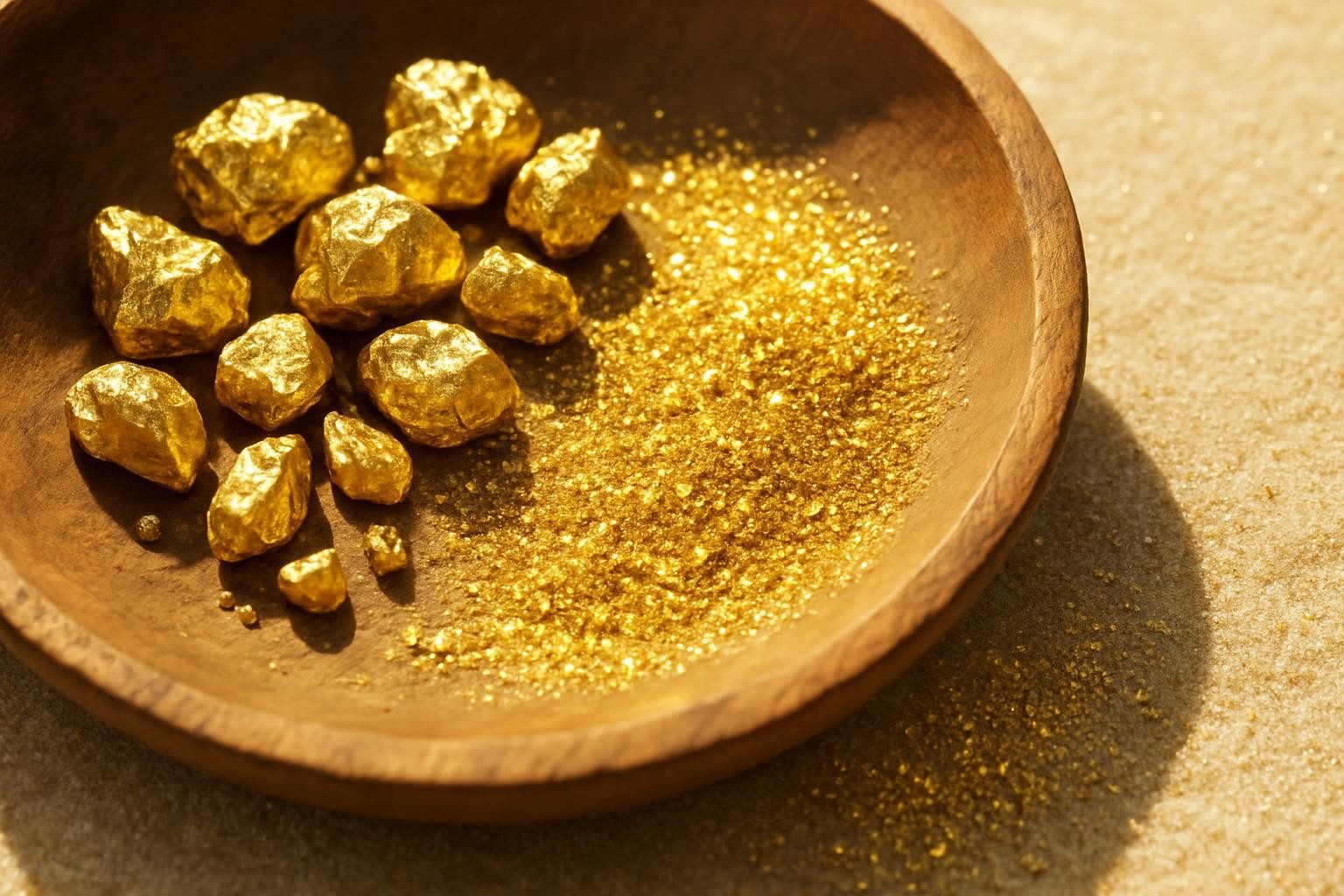
Ancient Egypt turned gold into an organised industry. From around 3000 BC Egyptian expeditions mined gold in the Eastern Desert and in Nubia — the land along the Nile in today’s southern Egypt and Sudan, whose name is often linked to nub, the Egyptian word for gold. The famous Turin Papyrus Map (c. 1150 BC) even shows the location of gold mines. Gold was the “flesh of the gods”: the funerary mask of Tutankhamun (c. 1323 BC) is made of more than 10 kg of solid gold.
The first gold coins: Lydia (c. 600 BC)
For thousands of years gold was traded by weight. That changed around 600 BC in the kingdom of Lydia, in today’s western Turkey, where the river Pactolus carried electrum — a natural gold-silver alloy. Lydian rulers began stamping small lumps of electrum with a lion’s head, creating the world’s first coins. Around 550 BC King Croesus introduced coins of refined gold and silver, so wealthy that “rich as Croesus” is still an expression today.
Rome and the aureus
Rome made gold the backbone of a continental economy. The gold aureus circulated across the empire, and Roman engineers mined on an industrial scale — at Las Médulas in north-west Spain, whole mountains were dismantled with hydraulic mining channels. In the 4th century AD the emperor Constantine introduced the solidus, a gold coin of about 4.5 g that stayed stable for some seven centuries.
The Islamic gold dinar (696 AD)
In 77 AH / 696–697 AD the Umayyad Caliph Abd al-Malik ibn Marwan issued the first purely Islamic gold coin, the dinar, struck to a standard weight of about 4.25 g and inscribed only with Arabic text. The dinar became one of the most trusted currencies of the medieval world, used from Spain to Central Asia, and its weight standard still serves as a reference in Islamic finance today.
Trans-Saharan gold routes
Between the 8th and 16th centuries much of the gold reaching the Mediterranean and the Middle East came from West Africa — from the fields of Bambuk, Bure and later the Akan region. Camel caravans crossed the Sahara carrying gold north and salt south. The wealth of the region became legendary in 1324, when Mansa Musa of Mali travelled to Mecca for Hajj with so much gold that its value in Cairo fell for years afterwards.
The great gold rushes
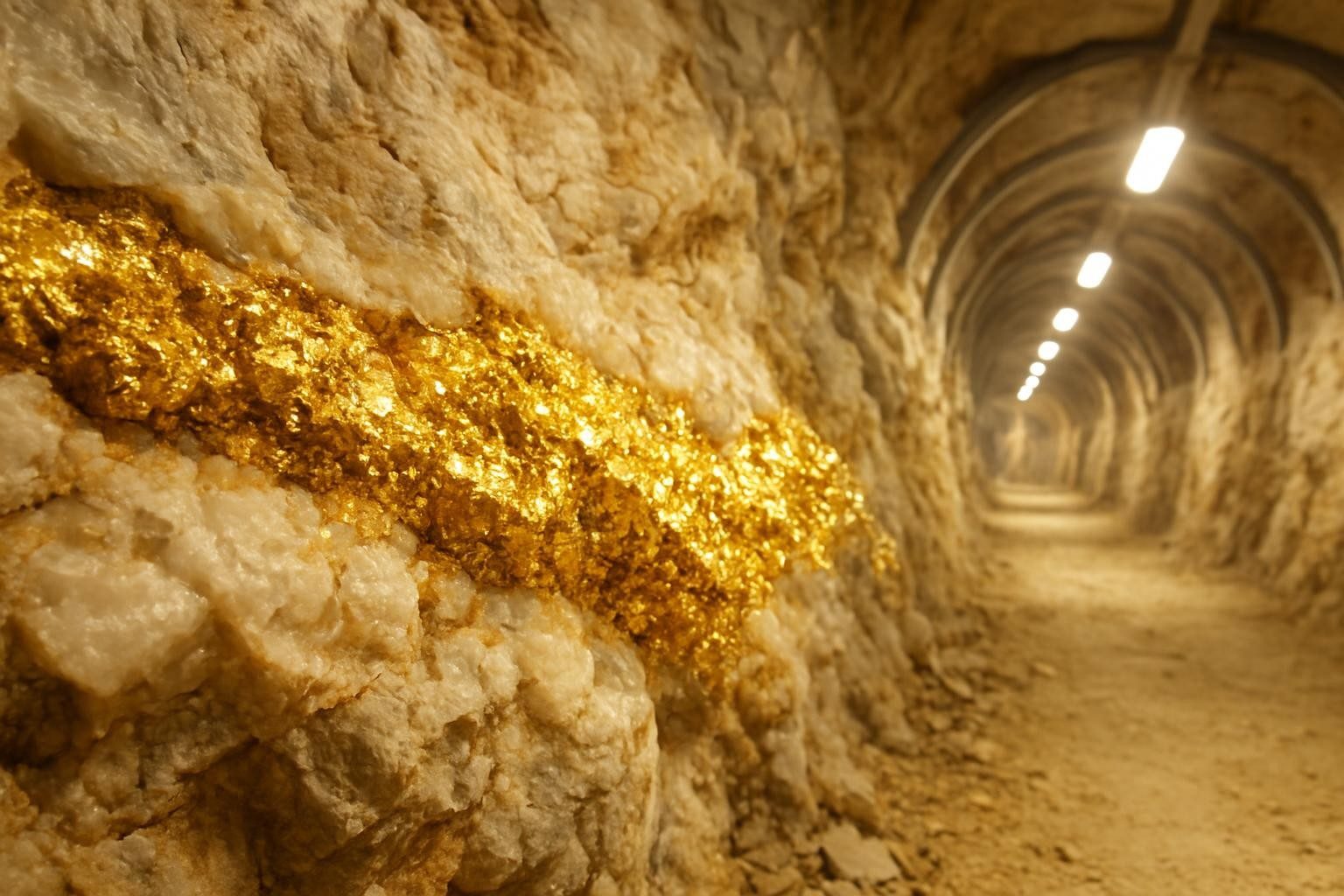
The 19th century turned gold into a global race. The California Gold Rush of 1848 drew some 300,000 people west; Australia followed in the 1850s, and the Klondike in Canada in 1896. The most important discovery came in 1886 on South Africa’s Witwatersrand, which became the richest goldfield in history — at its peak responsible for a large share of all gold ever mined. Hard-rock mining, deep shafts and new processing methods transformed gold from a prospector’s dream into a major industry.
The gold standard (1821–1971)
As trade grew, nations tied their currencies to gold. Britain formally adopted the gold standard in 1821, and by the late 19th century most major economies followed: a banknote could be exchanged for a fixed weight of gold. After the Second World War the Bretton Woods system (1944) fixed gold at US$35 per troy ounce, with other currencies pegged to the dollar. In 1971 the United States ended the convertibility of the dollar into gold, and gold became a freely traded asset — its price set every day by the global market.
Dubai: city of gold
Few places are as closely linked to gold as Dubai. Its traders built the city’s early prosperity, and the Deira Gold Souk — a few minutes from Al Muteena — remains one of the most famous gold markets in the world. Dubai’s position between the gold-producing regions of Africa and the great gold-consuming markets of South Asia and the Middle East, its free-trade infrastructure and its regulated trading environment have made it one of the leading global centres for physical gold, from raw doré bars to fine 999.9 bullion. Gold trading in Dubai is licensed by the Department of Economy and Tourism and supervised under UAE rules on responsible sourcing and anti-money-laundering.
Modern, mercury-free mining
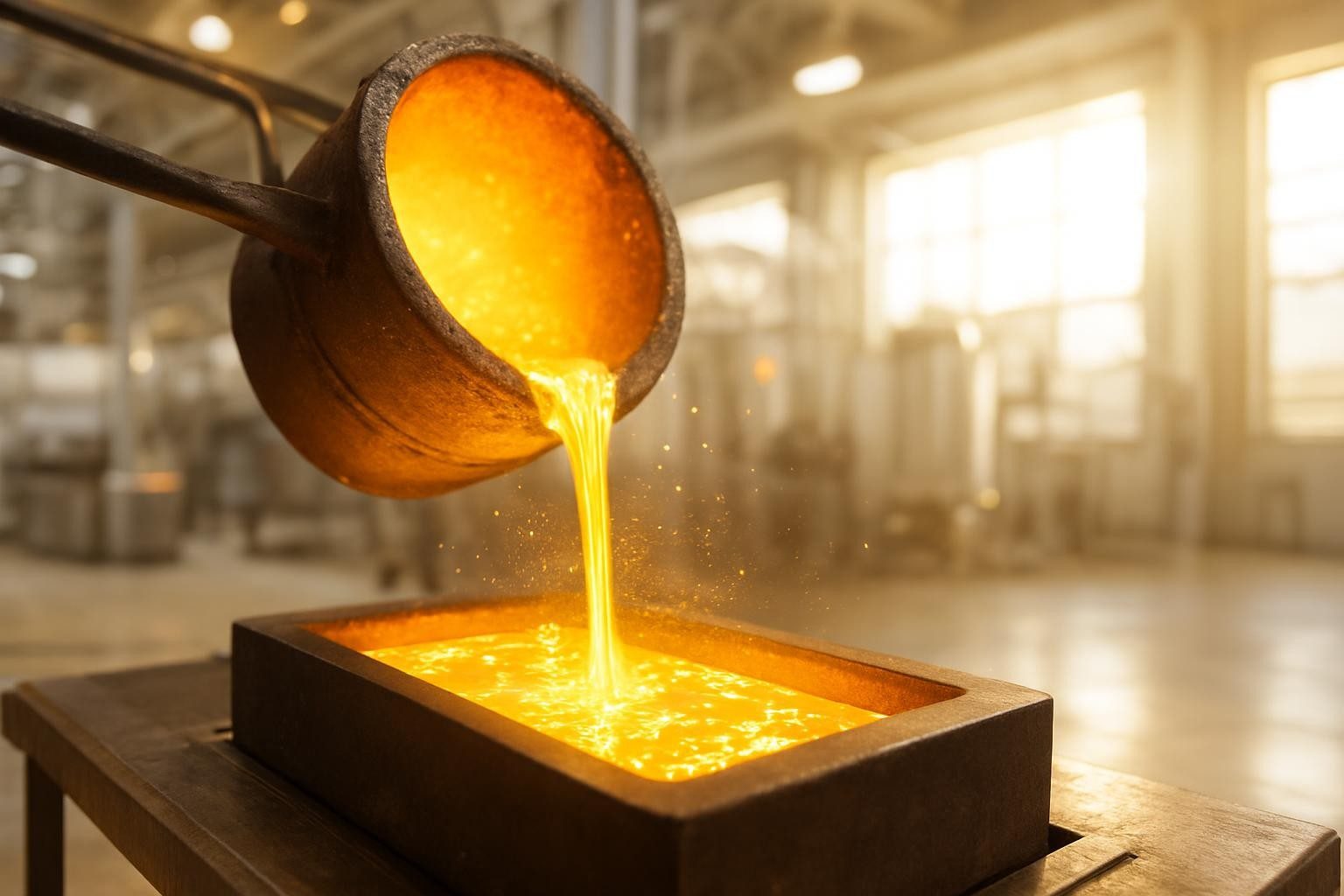
Today most gold comes from large open-pit and underground mines, while artisanal and small-scale mining still provides a significant share of supply. For centuries small miners used mercury to bind fine gold — a practice that poisons people, rivers and soil. The Minamata Convention on Mercury (adopted 2013, in force 2017) commits countries to reduce and eliminate it. Responsible mines now recover gold with gravity concentration (shaking tables and sluices), centrifugal concentrators and direct smelting with borax, recycling their process water in closed loops. The result is cast at the mine into doré bars, which are then assayed and refined.
At Rinan House Golds we trade raw gold only — doré bars, nuggets and mine-origin gold — and we work with mines and suppliers that follow ethical sourcing parameters and mercury-free recovery.
Purity & units explained
Raw gold is valued on what it truly contains: the weight × assayed purity gives the fine-gold content, which is priced against the international spot price. You can follow the live fine-gold price in AED and USD on our homepage.
Frequently asked questions
What is the oldest gold ever found?
The oldest worked gold known comes from the Varna Necropolis in Bulgaria, dated to roughly 4600–4200 BC — more than 6,000 years ago.
Who made the first gold coins?
The kingdom of Lydia, in today’s western Turkey, struck the first coins around 600 BC from electrum, a natural gold-silver alloy. Coins of refined gold followed under King Croesus around 550 BC.
What is a doré bar?
A doré bar is a semi-pure bar of gold cast at the mine. It typically contains gold plus some silver and other metals, and is valued on its assayed fine-gold content before being refined to 999.9.
What does 999.9 gold mean?
999.9 means 99.99% pure gold, also called “four nines” fine gold — the highest purity standard used for investment bars.
What is a tola of gold?
A tola is a traditional unit of weight used in South Asia and the Gulf. One tola equals 11.6638 grams; a “10 tola” bar weighs about 116.64 grams.
Why is Dubai a global gold hub?
Dubai sits between the gold-producing regions of Africa and the large gold-consuming markets of South Asia and the Middle East. Its historic Deira Gold Souk, free-trade infrastructure and regulated trading environment have made it one of the world’s leading centres for physical gold.
What is mercury-free gold?
Mercury-free gold is gold recovered without mercury amalgamation, using physical and thermal methods such as gravity concentration, centrifugal concentrators and direct smelting with borax. It protects miners, water and soil and is in line with the Minamata Convention on Mercury.